


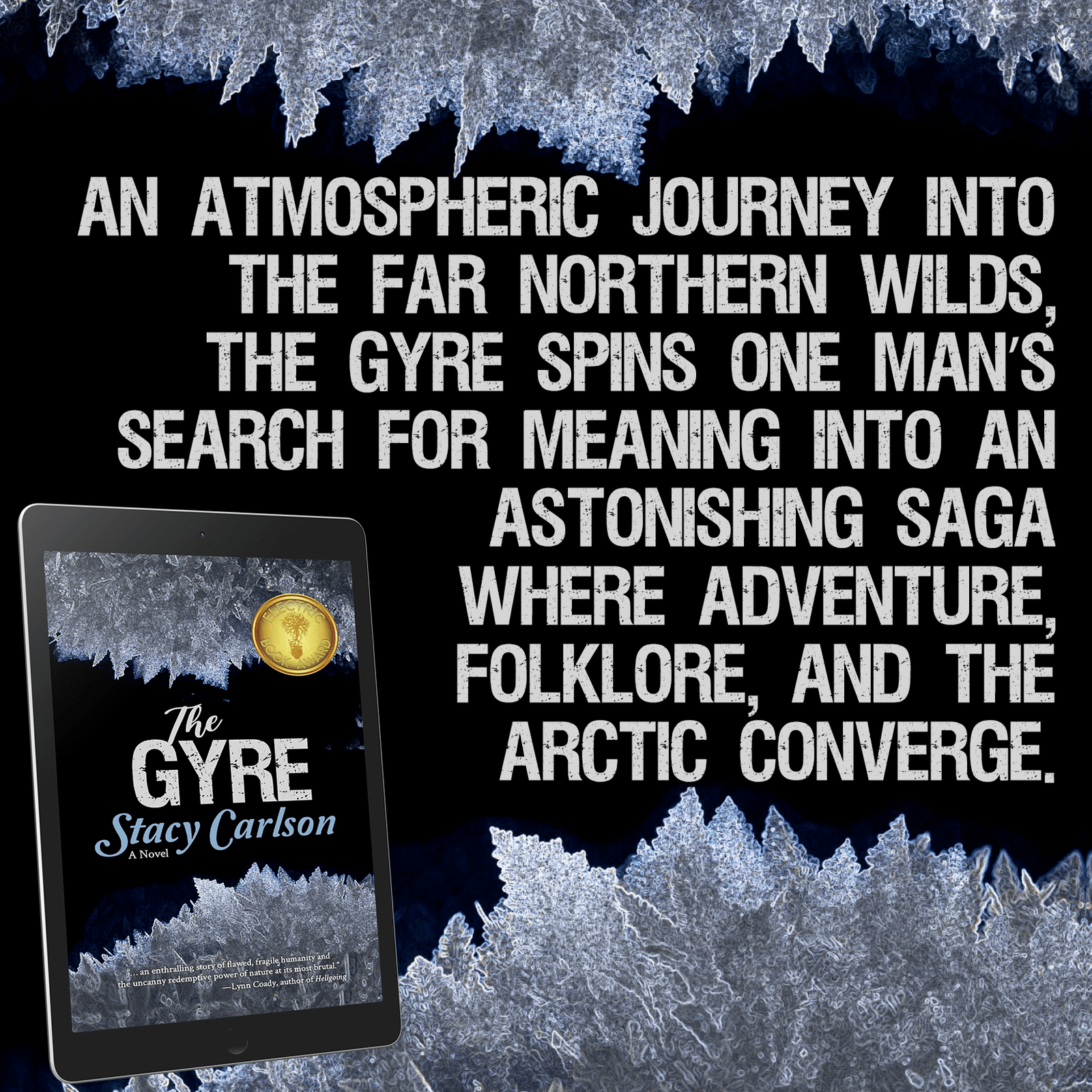
The Gyre
by Stacy Carlson
Genre: Literary Fiction, Dark Arctic Survival, Slavic
Magical Realism

***Winner of the
Electric Book Award***
Content Warning: language (mild), loss of faith, alcohol
consumption (mild), cannibalism (mild), violence, gore, starvation, animal
death, animal attacks, death, amputation, complications in childbirth,
kidnapping (mild).
What readers
are saying about the book:
“Stacy Carlson has written an enthralling story of flawed,
fragile humanity and the uncanny redemptive power of nature at its most brutal.
The Gyre is a journey through a stark, glittering wilderness,
an unforgettable landscape both terrible and holy in equal measure.”
—Lynn Coady, Giller Prize-winning author of Hellgoing
“Mythic journeys, fairy tales of ice and snow, sailors’
vodka-addled and lusty dreams, a monk’s poetic yearnings—The Gyre has
it all! As we follow Arkady Afanasyev on his journey into the farthest reaches
of the Arctic in search of his teacher and himself, we encounter story upon
story strung together, like pearls, showing us how we are connected to the
water, the ice, the ground, the light, and each other. The Gyre pulls
you in and in and into its profoundly beautiful spiral of a story.”
—Kathryn Nuernberger, author of Held: Essays in Belonging
“This is an absolutely astonishing saga, packed at every
turn with innumerable tangential sagas of survival, magic, incomprehensible
courage and persistence, and—always—the great, turning, harsh natural world. It
zooms the reader to a long ago and far away universe of struggle, quest, agony,
and enchantment. Fearlessly imagined and capably written, Stacy Carlson has
created a particular, complex, and searingly unforgettable mythology.”
—Joan Frank, author of Juniper Street: A Novel
“A gripping novel—both a rip-roaring yarn and a deep inquiry
into what makes us human. Like a Caspar David Friedrich painting,
Carlson’s The Gyre places the human against the immense
backdrop of an unforgiving landscape—here, the high-Arctic archipelago of
Svalbard—with dazzling results.”
—Colin Dickey, author of Ghostland: An American History in Haunted Places
and Afterlives of the Saints
Amazon * Alternating Current Press
* B&N * Kobo * Bookbub * Goodreads


From Chapter 17
In the morning, Arkady tucks his flint, steel, and tinderbox
into the pocket of his coat, which now he wears continuously, fully buttoned,
day and night. He packs up the rest of his camp and ponders the mossy
indentation that represents his earthly form.
Truly, it is better to fast than to starve. What else can
we humans do but exert our puny will and, by the contours of our effort,
see the framework upon which the universe is draped? What else can we
do? My earthly husk is hungry, though my spirit still feeds.
The clouds have retreated to the sky’s upper reaches, and an
elongated sunrise stretches a pale arm across the horizon. This triggers a
strange glow over the tundra plain: a variegated chorus of green and stone.
Arkady moves on. He crosses a subtle point of land that ebbs
into a narrow beach. Here, the stones reveal the outflow of a stream, whose
course has eroded a rift in the mountain. Far above, Arkady hears but cannot
see a waterfall. He drinks from the stream.
Foxes follow ice bears. That is their way. Foxes can hunt on
their own, of course, but here on Spitsbergen mostly they follow bears out onto
the ice. Arkady cannot say that foxes have faith, though his grandfather might
have said so. But foxes operate on the promise of left-behind blood and
entrails. Foxes follow ice bears. But this one follows Arkady.
As he drinks he watches the fox pick a delicate way across
the wet ground.
“The animals live by rules unknown to us. Mysterious rules, little
one. Rules we could learn from. If you are going to be wise about things, which
I know you shall, you will keep your mind open to the very different rules of
the four- and two-legged creatures of the earth. Do you hear?” His
grandfather’s voice is so close.
Arkady walks for some time, then turns on his heel and
kneels with one arm outstretched. He extends one quarter of one dried fish (a
full eighth of his last remaining food) southward and waits. The fox edges up, sniffs
the savory tidbit, bares his fangs, and plucks the torn fish from where Arkady
has set it on the stones. The animal growls and retreats with the morsel.
From behind a driftwood log, the girl-saint Vasilissa
frowns, confused by the human’s kindness. Each night when the fox comes to her
to sleep with its tail curled luxuriously at her neck, she feels its ribs poking
a little closer to the surface of its body. All night she hugs the animal
tightly and watches flat, gray clouds drift overhead. With the animal close to
her, she is part of this immense place; she creeps, hides, and persists just
like the delicate purple saxifrage blossoms she saw when she first arrived on
the island. With the animal near her, she is stronger. By loving it, she is
somehow more able to consider helping the human, although for now, she does not.
The tundra plain extends its wide palm along the coast, and
Arkady trudges in a daze of hunger through the afternoon. His prayers only skim
the surface of things, and he can’t shake the feeling that his grandfather is
walking just behind his right shoulder. Instead of a comfort, though, the presence
unhinges Arkady’s composure so that, for two hours, he can’t keep from looking
over his shoulder every few minutes.
Once, when he turns, the fox is following closely behind
him, and, using some of his small store of willpower, Arkady tears off a second
chunk of dried fish. This time the fox takes it directly from his hand. Walking
on, Arkady sucks his fingers for the salty residue. Then, he unwraps his prayer
rope from around his wrist and slips it into his pocket.
The third time he offers the fox a piece of fish, Arkady
trembles with hunger. Vasilissa watches from the slope just above them. The fox
will not go completely hungry today, and she is glad. She decides she will flag
down the next patron saint. The human deserves a kindness in return for this
one. Below her, by the curve of a stream, the fox plucks the last of the fish
from Arkady’s outstretched left hand, and, quick as he can, Arkady grabs the
animal by the throat with his other, gloved hand and holds on. He’s decided he
can bear the animal’s claws but probably not its teeth.
Arkady will never forget the way the fox fought for its
life. It drew both its hind legs close to its body and thrust them at Arkady again
and again, faster than he thought possible, with its claws outstretched. It
used these powerful tools to shred the wool in one section of Arkady’s coat and
to gash the skin of his right hand and wrist, and once even his face, as he
fought to secure those legs. The fox writhed and used its front claws as shield
and sword both, but a man’s arms are longer than a fox’s reach, and when a
creature is gripped by the throat, it is difficult to persevere. After he
secures the hind legs, Arkady shuffles on his knees to the bank of the stream
and plunges the fox into the icy water. Unfortunately for the fox, the water is
just deep enough, and Arkady’s hunger just strong enough, for the man to
succeed.
Vasilissa watches Arkady struggling with the fox and
gradually understands she is watching a battle to the death. Her sight
periscopes back and upward until she is a cloud observing a tiny diorama far
below. But when the human finally raises the fox’s limp and dripping form, the
whole scene collapses in on itself, and she goes blind with rage. Then,
inevitably, the pain unto death blooms into something else: She is no longer a
little girl. She is a figment, a force, and a bright, small terror adrift in
time. This knowledge fills her mind and heart, and her rage fades as suddenly
as it arose, and she is back in a stark northern land, kneeling on a cushion of
intricate moss filaments, clenching her fists.
Vasilissa rises and turns from the human world, because she can.
She glides over the ground. She continues up the scree slope, away from Arkady
and his pathetic travails. Vasilissa
will be folded into the mysteries of Spitsbergen, comforted by the crags, and nourished
by endless plains of ice and stone. In some future form, she will emerge from
this sanctuary, but for now, she disappears.


STACY CARLSON is a novelist, naturalist, and educator. Publishers Weekly called her debut novel, Among the Wonderful, “Intelligent, engrossing, and utterly unique.” Stacy’s essays and fiction have appeared in Tin House, Post Road, Inkwell, and elsewhere, and she has received fellowships and residencies from the Mesa Refuge, The Arctic Circle, Djerassi Resident Artists Program, and Signal Fire. Her background includes work as a historical ecologist, fish cannery worker, hot springs caretaker, and hiking guide in Big Sur. She grew up between mountains and sea in the Pacific Northwest and has lived in New England, New York, Northern California, and the Upper Midwest.
Website * Facebook * Instagram * Bluesky * Amazon * Goodreads




No comments:
Post a Comment